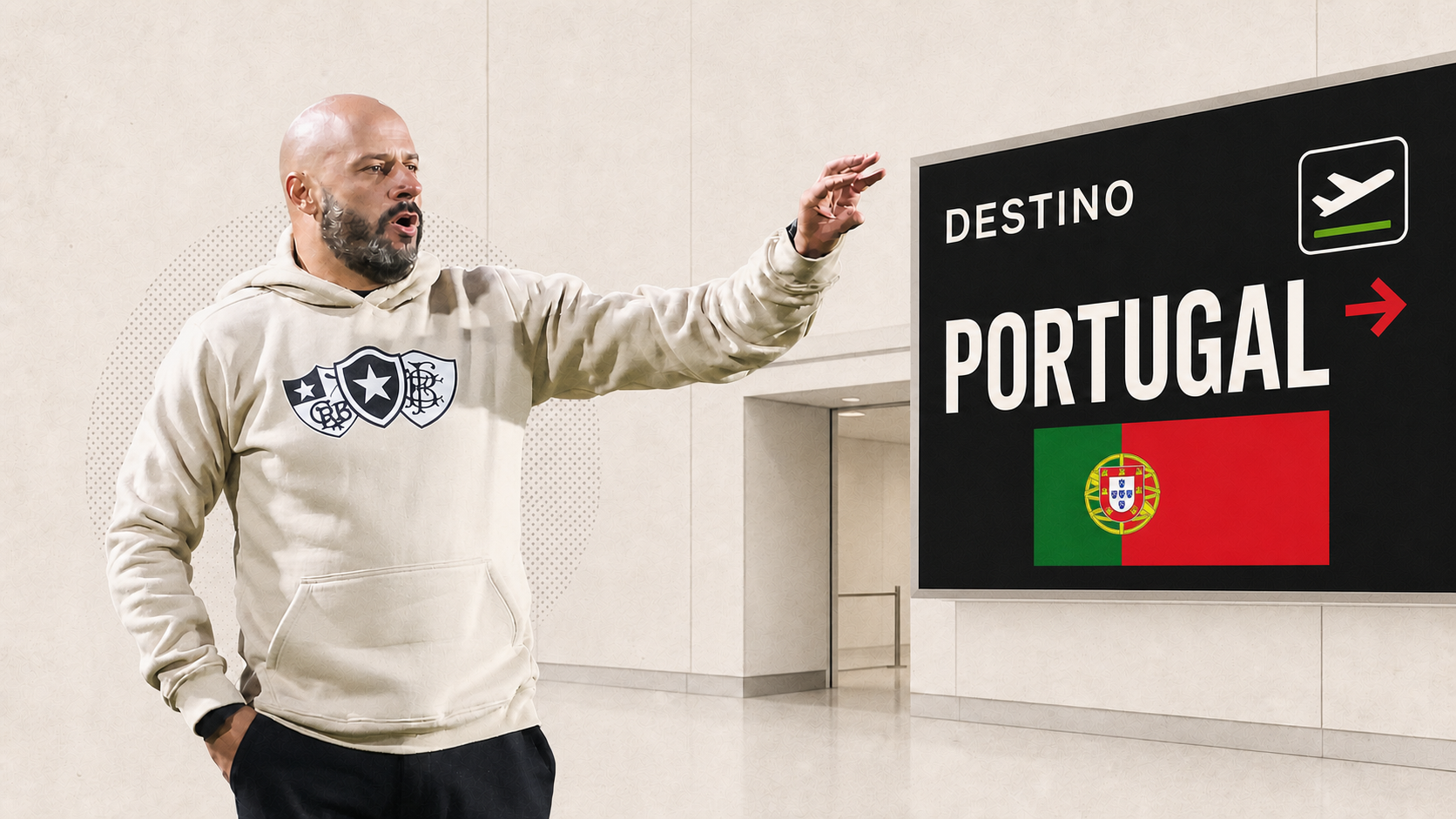
Franclim Carvalho said in May that working in the Portuguese league was one of his main career ambitions. He later clarified that he was not thinking of leaving
Botafogo at that point and was happy at the club. The board removed any ambiguity for him:
they sacked the coach and left him free to start looking for work in Portugal.
That is where the joke ends. I do not think
Franclim Carvalho was doing such a poor job that he deserved to be dismissed in August, midway through an already chaotic season. Changing the coach now does not solve what the squad and the board have failed to solve.
Franclim bore little blame for the 6-1 defeat
Losing
6-1 to Cienciano is unacceptable. Even so, I do not see
Franclim Carvalho as one of the main culprits for the scoreline. He prepared the team and picked the line-up, but it was the players who went onto the pitch and failed to compete in the first half in Cusco.
The coach selected
Mateo Ponte,
Marçal and
Kadir because they were part of the squad he inherited. His choices can be questioned, particularly the decision to change both full-backs, but these were the options available against an opponent who relied heavily on aerial balls.
Franclim Carvalho did not pull three tourists from outside the stadium and hand them shirts just before kick-off.
The plan failed, but the coach cannot play in place of his players. In my view, most of the blame belongs to their performance and the limitations of the squad. If fielding the available players is enough to justify a dismissal, the question should be why those are the players being offered to the coach.
The line-up against Vitória was not absurd
I did not see a disastrous line-up in the 1-0 defeat to
Vitória, either.
Franclim Carvalho used a normal core, with
Vitinho,
Nahuel Ferraresi,
Lucas Monzón and
Alex Telles in defence;
Cristian Medina,
Danilo and
Álvaro Montoro in midfield; and
Matheus Martins and
Arthur Cabral in attack.
One selection or another can always be debated, but there was no tactical invention that explained the defeat on its own.
Botafogo lost after
Huguinho conceded a penalty and produced
several very poor individual performances at the Barradão. The coach is responsible for the collective, not every misplaced pass or poor decision made on the pitch.
They were two poor results in a row, one of them a historic embarrassment. They still do not erase the rest of the work by themselves.
Franclim Carvalho left after 22 matches, with ten wins, seven draws and five defeats. It was not brilliant, but it was not the catastrophe his dismissal makes it appear to have been.
If the new board never wanted Franclim, they chose the worst time
Perhaps the new board never truly supported keeping
Franclim Carvalho, who could be seen as a legacy of
John Textor’s management and
Artur Jorge’s coaching staff. There is no public evidence that this was the motive. If that incompatibility existed, however, the way it was handled was even stranger.
When
Vasco negotiated with the coach in late June, the board had the perfect opportunity to end the relationship. Instead,
Franclim Carvalho stayed at
Botafogo and said the club’s directors had given him confidence. If the new management wanted to break with
John Textor’s legacy, that was the moment to do it. Keeping him when another club wanted him, then dismissing him a few weeks later, looks like a decision waiting for a disaster that could serve as justification.
Bellão is Franclim speaking Brazilian Portuguese
Rodrigo Bellão has taken over on an interim basis and deserves respect for his work in the academy. He has already managed the senior side in three matches, recording two wins and one defeat, and knows the club. None of that makes this change a technical revolution.
In the end,
Bellão is
Franclim Carvalho speaking Brazilian Portuguese: another young coach with little experience in charge of a senior team, promoted during an emergency and required to find answers within the same squad. I do not think he can fix it on his own. He may succeed, and I hope he does, but a change in accent does not produce automatic solutions.
This
Botafogo side is average and, based on what its players can deliver, should finish in the middle of the Brasileirão table. It may put together a good run and climb a few places, but there is not enough quality to demand that any coach turn the group into a natural contender for the top positions.
The mid-year transfer window was useful mainly because it replaced the calamity goalkeepers who had already cost the team far too much. That was an urgent and necessary correction. Elsewhere, average signings joined a squad that remained average. There were replacements, but no genuine step up in quality.
Any coach can organise the team better, adjust behaviours and revive players. He cannot turn squad fillers into leading men or create qualities the group does not possess. It might therefore have been more sensible to keep
Franclim Carvalho until the end of the year, demand improvements and prepare a change for the new season, with a coach aligned to the project, suitable signings and a full pre-season.
Sacking a coach in August creates the feeling of a response. Planning the change for January would have offered a better chance of a solution.
Botafogo chose the feeling.
At least
Franclim Carvalho received some unexpected help in pursuing his professional goal. He wanted to work in the Portuguese league one day, and now he has free time to send out his CV. The question is whether
Botafogo, after helping him with his ambition, moved even an inch closer to fulfilling their own.